Math 140

Class 15

Inverse Trigonometric Functions

  • Trigonometric functions are not one-to-one!
  • We must restrict their domains to make them invertible.
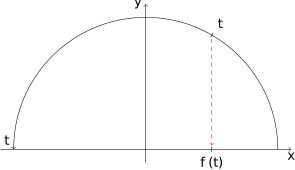
  • Trigonometric functions are projections from number circle (\(t\)-axis) to other axes.
  • Inverse trigonometric functions will be projections from other axes to the number circle.

Inverting Cosine (domain restriction)

  • Cosine is one-to-one on:
    • Upper semicircle:
      • \(2k\pi \le t \le (2k+1)\pi\)
      • Cosine is decreasing on this interval.
    • Lower semicircle:
      • \((2k - 1)\pi \le t \le 2k\pi\)
      • Cosine is increasing on this interval.
  • Standard choice: upper semicircle with \(k = 0\): \(0 \le t \le \pi\).

Inverting Cosine (domain restriction)

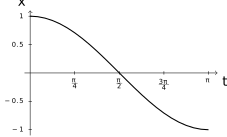
Define function \(f(t) = \cos t, 0 \le t \le \pi\).

Properties:

  • Domain: \([0, \pi]\)
  • Range: \([-1, 1]\)
  • Decreasing
  • \(f(0) = 1\)
  • \(f(\pi) = -1\)

Inverting Cosine (domain restriction)

Inverting Cosine (actual inversion)
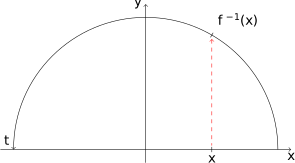
We defined the function \(f(t) = \cos t, 0 \le t \le \pi\).

\(f\) is one-to-one, so it can be inverted.

  • Domain of \(f\): \([0, \pi]\)
  • Range of \(f\): \([-1, 1]\)
  • \(f\) is decreasing
  • \(f(0) = 1\)
  • \(f(\pi) = -1\)
  • Domain of \(f^{-1}\): \([-1, 1]\)
  • Range of \(f^{-1}\): \([0, \pi]\)
  • \(f^{-1}\) is decreasing
  • \(f^{-1}(-1) = \pi\)
  • \(f^{-1}(1) = 0\)

Inverting Cosine (actual inversion)

Inverting Cosine (notation)

\(f(t) = \cos t, 0 \le t \le \pi\).

The \(f^{-1}\) is called the inverse cosine or arccosine, denoted as

  • \(\cos^{-1}\)
  • \(\arccos\)
  • \(\operatorname{acos}\)

Inverse cosine projects from the \(x\)-axis to the upper semicircle.

Example: symmetry: \(\arccos(-x) = \pi - \arccos(x)\)

Inverting Sine (domain restriction)
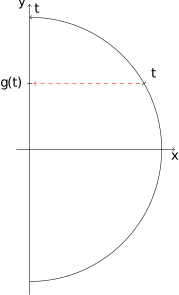
  • Sine is one-to-one on:
    • Right semicircle:
      • \(\left(2k-\frac{1}{2}\right)\pi \le t \le \left(2k+\frac{1}{2}\right)\pi\)
      • Sine is increasing on this interval.
    • Left semicircle:
      • \(\left(2k + \frac{1}{2}\right)\pi \le t \le \left(2k + \frac{3}{2}\right)\pi\)
      • Sine is decreasing on this interval.
  • Standard choice: right semicircle with \(k = 0\): \(-\frac{\pi}{2} \le t \le \frac{\pi}{2}\).

Inverting Sine (domain restriction)

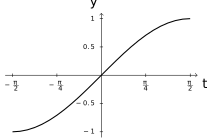
Define function \(g(t) = \sin t, -\frac{\pi}{2} \le t \le \frac{\pi}{2}\).

Properties:

  • Domain: \(\left[-\frac{\pi}{2}, \frac{\pi}{2}\right]\)
  • Range: \([-1, 1]\)
  • Increasing
  • \(g\left(-\frac{\pi}{2}\right) = -1\)
  • \(g\left(\frac{\pi}{2}\right) = 1\)

Inverting Sine (domain restriction)

Inverting Sine (actual inversion)
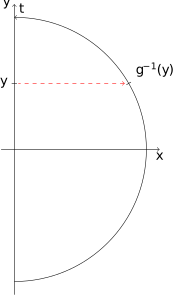
We defined the function \(g(t) = \sin t, -\frac{\pi}{2} \le t \le \frac{\pi}{2}\).

\(g\) is one-to-one, so it can be inverted.

  • Domain of \(g\): \(\left[-\frac{\pi}{2}, \frac{\pi}{2}\right]\)
  • Range of \(g\): \([-1, 1]\)
  • \(g\) is increasing
  • \(g\left(-\frac{\pi}{2}\right) = -1\)
  • \(g\left(\frac{\pi}{2}\right) = 1\)
  • Domain of \(g^{-1}\): \([-1, 1]\)
  • Range of \(g^{-1}\): \(\left[-\frac{\pi}{2}, \frac{\pi}{2}\right]\)
  • \(g^{-1}\) is increasing
  • \(g^{-1}(-1) = -\frac{\pi}{2}\)
  • \(g^{-1}(1) = \frac{\pi}{2}\)

Inverting Sine (actual inversion)

Inverting Sine (notation)

\(g(t) = \sin t, -\frac{\pi}{2} \le t \le \frac{\pi}{2}\)

The \(g^{-1}\) is called the inverse sine or arcsine, denoted as

  • \(\sin^{-1}\)
  • \(\arcsin\)
  • \(\operatorname{asin}\)

Inverse sine projects from the \(y\)-axis to the right semicircle.

Example: symmetry: \(\arcsin(-y) = - \arcsin(y)\)

Inverse Properties

  • \(\cos(\arccos(x)) = x\) for every \(x \in [-1, 1]\).
  • \(\sin(\arcsin(y)) = y\) for every \(y \in [-1, 1]\).
  • \(\arccos(\cos(t)) = t\) for every \(t \in [0, \pi]\).
  • \(\arcsin(\sin(t)) = t\) for every \(t \in \left[-\frac{\pi}{2}, \frac{\pi}{2}\right]\).

Question: What is \(\arccos\left(\cos\left(\frac{34\pi}{7}\right)\right)\)?

Question: What is \(\arccos\left(\cos\left(\frac{17\pi}{5}\right)\right)\)?

Inverse Tangent